
HOW IT WORKS
A simple Card.
Critical Information.
When It Matters Most.
A HOPE Card is a wallet-sized summary of a protection order designed to help survivors carry essential information and help law enforcement verify and respond more efficiently.
The survivor receives or requests a HOPE Card through a participating program.
01 Request
Essential protection-order information is placed on a durable, wallet-sized card that can be kept in a pocket, wallet, purse, or on a lanyard.
02 Carry
Law enforcement can use the card information to help identify the order and verify it through official sources.
03 Verify
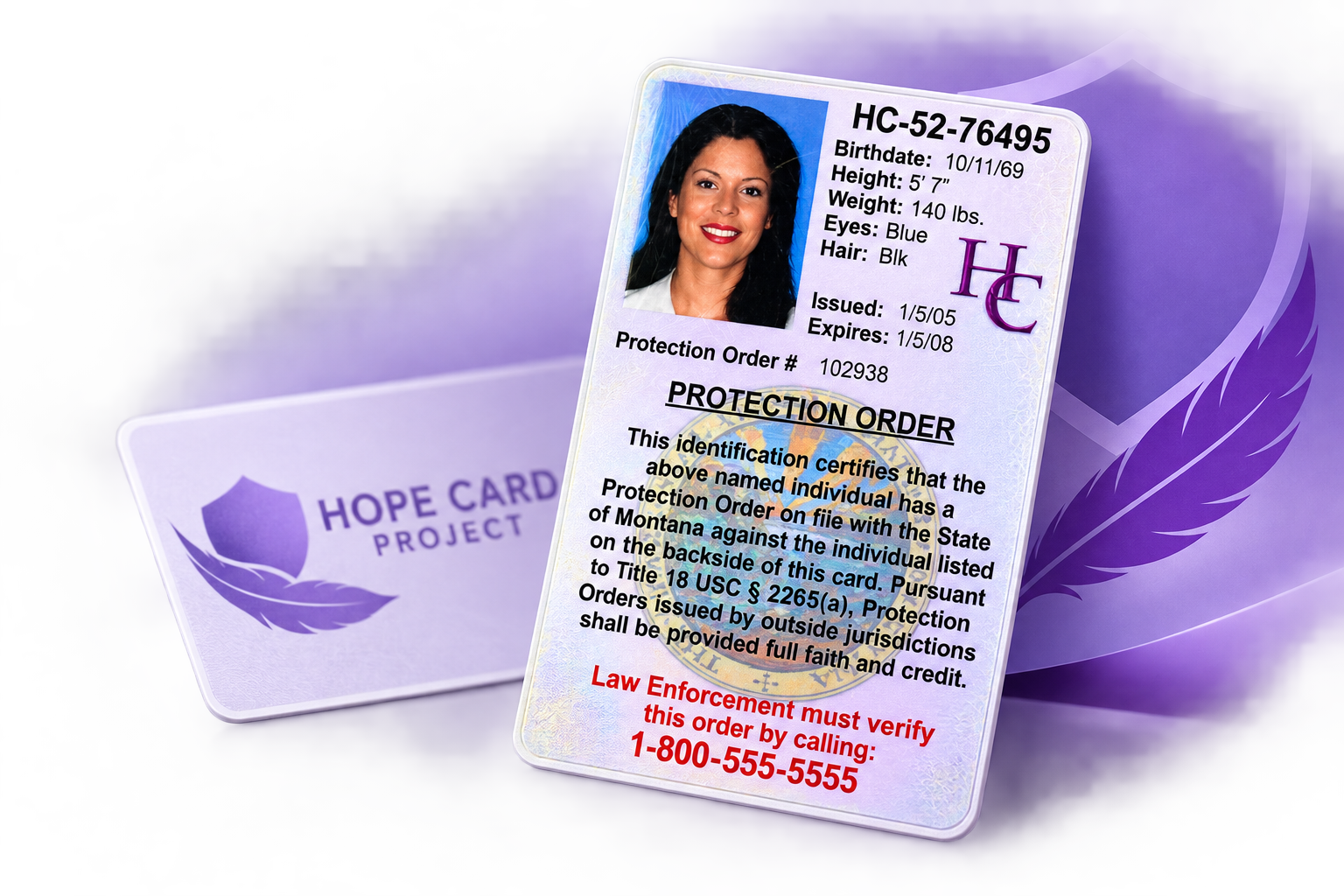
WHAT’S ON THE CARD
Critical information, organized for the field.
The HOPE Card is designed to present key protection-order information in a format that is quick to read and easy to carry.
1. Authority
Issuing government seal and HOPE Card verifier.
2. Identity of Both Parties
Protected and restrained person information, including name, date of birth, description, and photo when available.
3. Prohibited Conduct
No-contact provisions, distance requirements, weapons restrictions, and other key conditions.
4. Order Validity
Effective dates, expiration date, issuing court, and case number.
5. 18 U.S.C. § 2265
A reminder that qualifying protection orders are enforceable across jurisdictions.
6. Important Limitation
The HOPE Card does not replace the official protection order and must still be verified through official sources.
WHY IT MATTERS
Protection orders only work when they can be recognized, verified, and enforced.
Survivors may not have a readable copy of the order with them. Officers may have difficulty confirming an order from another jurisdiction, identifying the restrained person, or finding the order in a registry. The HOPE Card is designed to make that critical information easier to access at the moment it is needed.
01
Orders Aren’t Always Available
A survivor may not have a readable copy when law enforcement needs it.
02
Verification Can Take Time
Orders from other jurisdictions may be difficult to locate or confirm quickly.
03
Identity Matters
Officers need reliable information to identify the parties and understand the order.
DESIGNED FOR THE FIELD
Built to support faster, clearer enforcement.
The HOPE Card organizes essential protection-order information in a format designed for quick review during a law-enforcement response. It helps officers identify the parties, understand key restrictions, and locate the information needed to verify the order through official sources.
QUICK FIELD REFERENCE
Identify
Names and identifying information for the protected and restrained parties.
Understand
Key restrictions, prohibited conduct, and important order conditions.
Verify
Issuing court, case information, effective dates, and other details needed to confirm the order through official sources.
FULL FAITH AND CREDIT
Protection should not stop at a jurisdictional boundary.
Federal law provides for qualifying protection orders to receive full faith and credit across jurisdictions. The HOPE Card helps place the key information needed for that process into a form that is easier to carry, recognize, and review in the field.
18 U.S.C. § 2265
A valid protection order issued by one state, tribe, or territory may be enforceable in another jurisdiction. The HOPE Card does not replace the underlying order, but it helps officers identify the order and the information needed to verify it through official sources.
What it means in practice
IMPORTANT LIMITATION
The HOPE Card does not replace the official protection order.
The card is a portable summary designed to help make critical information easier to access. Law enforcement must still verify the underlying protection order through official sources.
Explore current HOPE Card programs and see how jurisdictions are implementing the project.